Retro Pop Art Sticker Icons: A Designer's Review
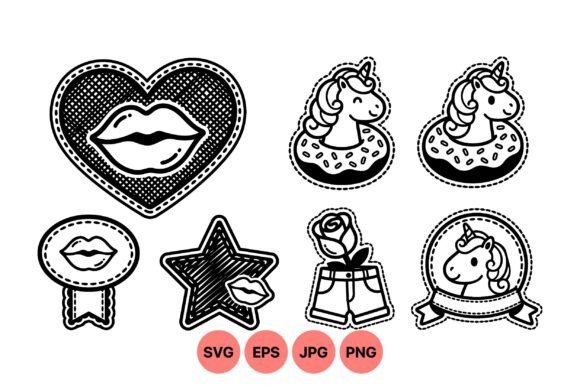
When I first pulled up the Retro Pop Art Sticker Icons on my screen, I didn't just see a collection of digital files; I saw a potential bestseller for my upcoming spring market booth. As someone who spends hours digitizing and stitching for clients, I approach every new embroidery file with a critical eye. Will this hold up under the needle? Does it translate well from vector to thread? These icons, featuring minimalist black and white line art of unicorns with donut collars, lips, hearts, stars, and that quirky rose in shorts badge, immediately struck me as perfect for the current trend toward playful, graphic aesthetics in custom apparel.
First Impressions and Visual Personality
The mood of this set is undeniably cheerful and slightly irreverent. In the world of Illustrations and Graphics, minimalism can sometimes feel cold or sterile, but these designs manage to retain a warm, hand-drawn charm. The lines are clean, which suggests they were created with precision, likely making them excellent candidates for conversion into a machine embroidery design. The lack of complex shading means we aren't dealing with thousands of unnecessary stitches, which is a huge plus for production speed.
What stands out most is the "sticker" aesthetic. This style mimics the look of a vinyl decal or a printed patch, which is incredibly popular right now among younger demographics. When I imagine these stitched out, I picture bold outlines—perhaps using a satin stitch for the borders and a light fill stitch or even just running stitch details for the internal features. The visual personality is loud without being cluttered, making it ideal for projects where you want the design to pop without overwhelming the garment.
Real-World Application: The Tote Bag Test
To truly evaluate the Retro Pop Art Sticker Icons, I mentally ran through a specific project scenario: a custom order for a local boutique needing a run of branded tote bags. They wanted something fun but professional enough to be carried daily. I selected the unicorn with the donut collar and the star icon for this test.
On a heavy canvas tote, these designs would shine. The sturdy fabric texture of canvas provides the stability needed for crisp lines. I envision using white thread on a natural beige bag or black thread on a navy blue one. The contrast is key here. Because the designs are essentially line art, they rely heavily on the relationship between the thread color and the background fabric. If the contrast is too low, the "sticker" effect is lost, and the design looks muddy. However, with high contrast, the result is a sharp, modern handmade product that feels curated rather than generic.
For a sweatshirt embroidery project, these icons would work beautifully on the chest or sleeve. Imagine a oversized grey hoodie with a small embroidered heart or lips on the left chest. It adds a touch of personality to a basic garment, elevating its perceived value. For baby embroidery, the unicorn and star motifs are gentle and whimsical, perfect for a onesie or a nursery blanket, provided the stitch density is adjusted to remain soft against sensitive skin.
Versatility Across Product Lines
The beauty of this set lies in its adaptability. Beyond apparel, these design assets are prime candidates for embroidered patch creation. Since the shapes are distinct and self-contained, they can easily be digitized as merrow-edge patches or cut-and-sew applications. This opens up revenue streams for Etsy sellers and craft business owners who sell accessories rather than just clothing.
I also see strong potential for home decor. A set of kitchen tea towels featuring the rose in shorts badge and the lips shape could make a fantastic holiday gift or housewarming present. The playful nature of the icons breaks up the monotony of standard kitchen linens. Furthermore, for those selling digital embroidery files, offering these as part of a "Pop Art Pack" could attract buyers looking for quick, impactful projects for their own small shop products.
Technical Considerations and Stitching Challenges
While the aesthetic is strong, a responsible designer must address the technical realities of stitching these icons. Minimalist line art can be deceptively tricky. Thin lines require precise tension settings. If your machine tension is off, a running stitch meant to be crisp might look wavy or loose.
There are specific scenarios where you need to proceed with caution. If you are working with stretchy fabric like jersey knit, the lack of substantial fill in these designs means there is less structural support to prevent puckering. Using the correct stabilizer is non-negotiable here; a cut-away stabilizer might be necessary even for lightweight fabrics to maintain the integrity of the lines over time. Similarly, on dark fabric, you must ensure your thread has enough coverage. A single strand of running stitch might get lost in the nap of a dark fleece, so you may need to adjust the stitch count or thickness during digitizing.
Curved surfaces, such as caps, present another challenge. The flat, graphic nature of these stickers might distort if placed on the highly curved front panel of a baseball cap without proper hooping techniques. It is often better to place these on the side panels or the back of a cap where the surface is flatter. Additionally, tiny details within the icons, like the sprinkles on the donut or the petals of the rose, need to be checked for minimum stitch length. If they are too small, they may not stitch out cleanly and could thread-bunch, ruining the finished product.
Enhancing Brand Value and Customer Trust
Using high-quality, cohesive designs like Retro Pop Art Sticker Icons directly impacts your brand perception. When a customer receives a personalized gift or a piece of custom apparel with clean, intentional embroidery, it builds trust. It signals that the maker cares about the details. Inconsistent or poorly executed designs can make a business look amateurish, but a well-chosen, well-stitched graphic reinforces professionalism.
For commercial embroidery projects, consistency is everything. If you are branding a team or creating merchandise for an event, these icons offer a unified visual language. They are recognizable and memorable, which aids in buyer engagement. A customer is more likely to remember a brand that uses a unique unicorn-with-a-donut motif than one that uses a generic stock flower.
Practical Notes for the Embroiderer
Before committing to a full production run, I always recommend a few practical steps. First, test the design on scrap fabric that matches your final material. This allows you to check thread color contrast and stitch density without risking expensive goods. Review how the design looks in both black and white mockups to ensure it holds up without color reliance.
Always confirm the hoop size requirements. While these icons look small, some may have extensions that require a larger hoop than expected. Inspect the small details closely after the test stitch-out; are the corners sharp? Is the underlay sufficient? Finally, and perhaps most importantly, check the licensing terms. Ensure that the Retro Pop Art Sticker Icons are cleared for commercial embroidery if you plan to sell the finished items or use them in client work. Never assume a license covers unlimited commercial use without reading the fine print.
In conclusion, this set of Illustrations offers a fresh, vibrant option for modern makers. With careful attention to fabric choice, stabilization, and thread contrast, these icons can transform simple blanks into standout pieces. Whether you are an Etsy seller looking to expand your catalog or a hobbyist making gifts, the Retro Pop Art Sticker Icons provide a solid foundation for creative, profitable, and visually striking embroidery projects.